






“AI consulting” covers a wide range of work. For one firm it means a two-hour workshop. For another it means a six-month strategy programme that ends with a report. For a third it means engineers who sit with your team, find the right workflow and build the system.
All three are sold under the same name, so it is easy to buy the wrong one. This guide breaks down what AI consulting services usually include, which kind fits which situation, and what to check before you sign.
Key takeaways
- AI consulting services help a company decide where AI is worth using, plan how to do it, and in many cases build it into existing systems.
- The work usually covers readiness assessment, AI strategy, opportunity discovery, solution design, proof of concept, implementation and training. Not every company needs all of them.
- The main difference between providers is whether the consulting stops at a recommendation or carries it through to a working system.
- A useful AI strategy names specific workflows, owners and success measures, not general directions.
- Before hiring, ask who does the work after the strategy phase, how the provider will work with your existing systems, and what would make them recommend stopping.
- Neurony is an AI integration and AI-powered custom software development company: it shows companies where AI creates value and then builds it into their operations.
- Neurony works as a long-term partner rather than a one-off advisor. Mateco, for example, has worked with Neurony since 2006.
What are AI consulting services?
AI consulting services help a company decide where AI is worth using, plan how to do it, and in many cases build and run it. The work usually spans four areas: assessing readiness, finding and ranking opportunities, designing the solution, and implementing it inside existing systems and workflows.
The distinction that matters is between consulting that stops at a recommendation and consulting that carries the recommendation through to a working system.
When does a company need AI consulting?
Outside help tends to pay off in a few recognisable situations:
- Your team uses AI tools, but business performance hasn’t changed. Licences are paid for, a few people experiment, and no process runs differently.
- You have several AI ideas and no way to choose between them. Each department has a candidate, and nobody can say which one is worth the budget.
- The process you want to improve crosses several systems. Anything that touches an ERP, a CRM and a shared inbox at once is an integration problem as much as an AI problem.
- Off-the-shelf tools don’t fit your workflows or data. The tool works in the demo, but not with the way your orders, documents or approvals actually move.
- A previous pilot stalled. It worked in a demo and never made it into daily operations.
If none of these apply and you already know exactly what to build, you may need delivery capacity rather than consulting.
What AI consulting services include
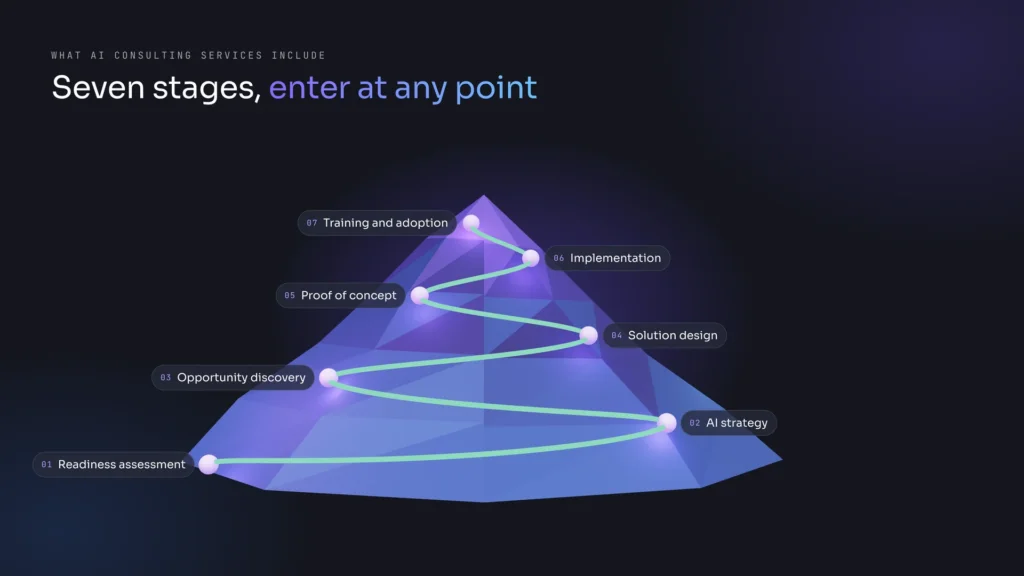
Most AI consulting work falls into the stages below. A good provider will tell you which ones you need, rather than selling all of them by default.
AI readiness assessment
A first diagnosis of where the company stands: its processes, data, systems and people, and where the gaps are. It is the lowest-commitment way to start, and it gives the rest of the work a baseline. Neurony’s AI readiness assessment produces a tailored view of opportunities, gaps, risks and next steps.
AI strategy consulting
AI strategy consulting answers the leadership questions: which business goals AI should serve, which opportunities come first, what to build versus buy, and how to measure success. It is where many engagements start and, too often, where they end.
A strategy is only useful if it names specific workflows, owners and success measures. “Use AI to improve customer service” is a direction. “Automate first-line answers to order-status questions, with a person handling exceptions, measured by response time” is something a team can act on.
At Neurony, this alignment work is a working session, AI Worth Doing, that brings leadership, technical and operational teams together and ends with a go/no-go direction and prioritized solution options.
Opportunity discovery inside the operation
Workshops capture what people say about their work. Watching the work itself often shows something different: the spreadsheet that holds the real process together, the inbox where orders actually arrive, the step everyone works around.
Neurony’s Forward Deployed Engineer engagement places an engineer inside the partner’s operation. The result is a map of AI opportunities, sorted into immediate action, integration or custom build.
Architecture and solution design
Before building, someone has to define the data flows, the integrations with existing systems, the risks, and who owns what. Skipping this step is how AI projects end up as separate tools nobody connects to the ERP. Neurony’s Designing the AI Blueprint engagement covers this work: data flows, integrations, architecture, risks, ownership and the implementation path.
Proof of concept
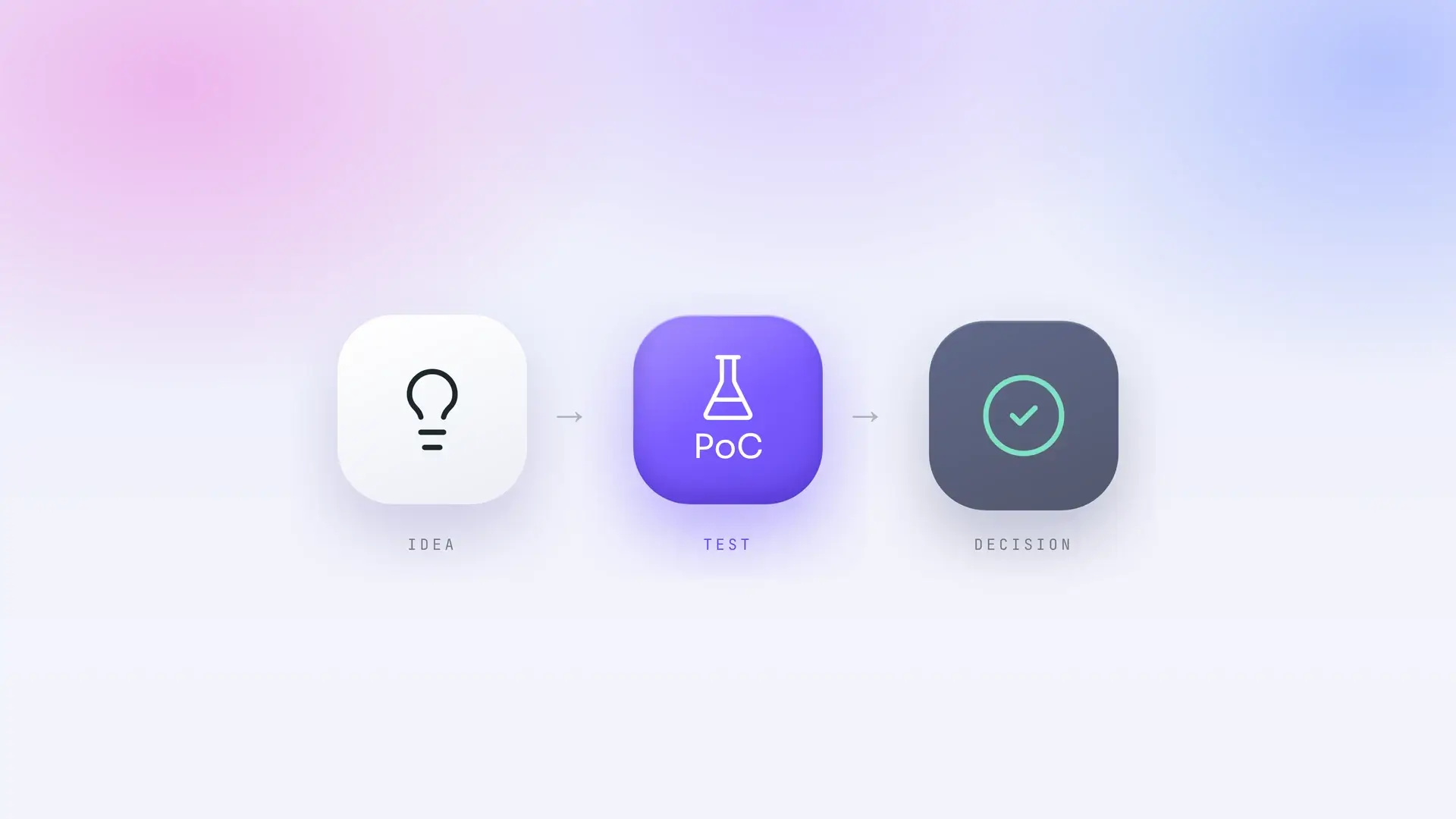
A proof of concept tests one chosen opportunity with a simplified working system and ends with a decision to build, adjust or stop. It is the cheapest point at which to find out an idea doesn’t work.
Implementation, training and adoption
This is where advice-only consulting stops. Implementation means integrating the solution into the systems you already run, handling exceptions, monitoring results, and training the people who use it every day, so they understand and trust the new way of working.
Advice-only consulting vs consulting tied to delivery
The biggest risk in buying AI consulting is paying for a strategy that never becomes a system. Recommendations written by people who won’t build them tend to underestimate integration work, overestimate data quality, and leave the hardest part to someone else.
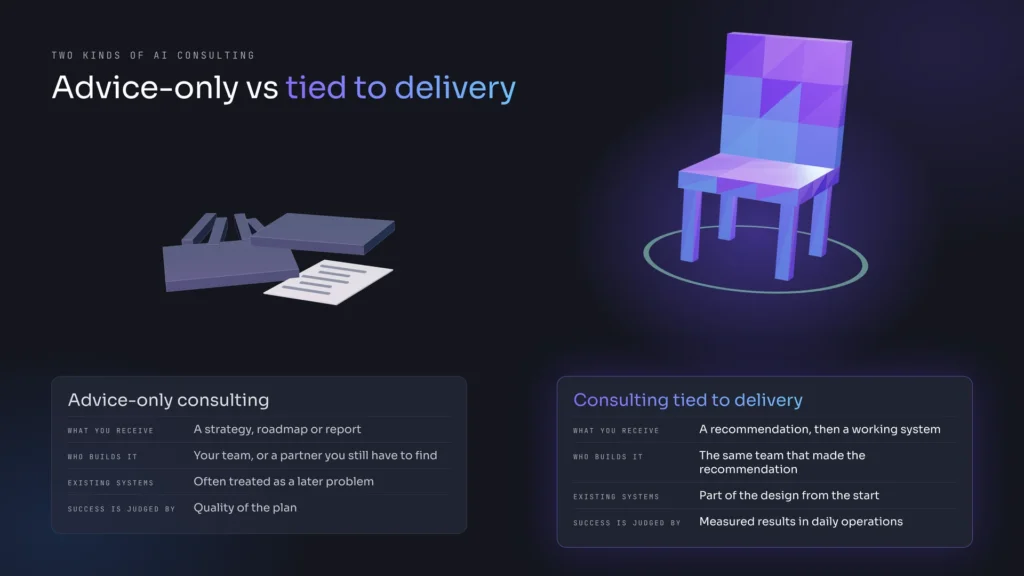
A provider that also builds has to live with its own recommendations. That changes what it recommends. It favours one workflow done properly over ten ideas in a slide deck, and it is more likely to say when conventional software, automation or a change to the process would do the job better than AI.
This is how the work has gone at Neurony. In the Meesenburg implementation, 98% of processed orders required no manual modification. Orders that arrived by email and as documents had been typed into the ERP by hand; the automated process moved from pilot into production. For Mateco, a Neurony partner since 2006, the automated balance-confirmation process reduced administrative time by approximately 80%. Both started from one specific workflow.
Questions to ask before you hire an AI consultant
A few questions separate firms that can deliver from firms that mainly advise:
- Who will do the work after the strategy phase? If the answer is “your team” or “a partner we’ll recommend”, you are buying advice only.
- Can you show a system that went from pilot into daily operations? Demos and pilots are common. Production results are rarer.
- How will you work with our existing systems? A credible answer names your ERP, CRM or data sources, not a generic platform.
- How will we measure success, and when? Look for a baseline and a threshold agreed before the build starts.
- What would make you recommend stopping? A provider that never says no has no reason to.
If you are still deciding whether to bring in outside help at all, our guide to in-house vs partner AI implementation lays out the trade-offs.
How Neurony works with partners on AI
Neurony is a Romania-based AI integration and AI-powered custom software development company. Neurony’s software-development experience dates back more than two decades, and Neurony works with partners in Romania and international markets. Neurony is also a Claude Select Services Partner in Anthropic’s Claude Partner Network.
Neurony works with small and mid-market organizations with complex operations. The work starts with the partner’s real workflows, systems and constraints, not with a model or a tool. From there, the stages above form a journey you can enter at any point: readiness assessment, alignment, operational discovery, blueprint, proof of concept, implementation, and training. Most partners start with one workflow and add the next once the first runs in daily operations. That is why many of Neurony’s partnerships last for years: Mateco has worked with Neurony since 2006, and the online car insurance broker behind Neurony’s document verification work is a long-standing partner. Each new workflow builds on systems Neurony already knows from the inside.
Every stage follows Value-Driven Development: define the value up front, validate before scaling, integrate into existing systems rather than layering on top, and measure after release. The full path is set out in our AI adoption roadmap.
Not sure which kind of help you need?
Start with the AI readiness assessment. It shows where AI could create value in your business, what is in the way, and which next step fits.
Take the AI readiness assessment
If you already have a workflow in mind, book a call and we’ll look at it with you. See how we work on the Forward Deployed Engineer page.