







AI is making individual tasks faster, but most companies outside big tech aren’t seeing higher profit margins or revenue per employee. The main reason is how AI is introduced: one department or task at a time, while the processes around it stay the same. That’s why AI ROI so often stays invisible. Financial results improve when AI changes how work moves through the whole business.
Key takeaways
- Apollo’s chief economist found flat profit margins and revenue per employee across 493 S&P 500 companies outside big tech.
- AI gains stay local when the surrounding processes, systems and decisions don’t change.
- Not every improvement in an AI transformation needs AI. Integration and conventional software often matter just as much.
- AI ROI should be measured against a specific business objective, not the technology itself.
- The best starting point is tracing how one important piece of work moves through the organization, end to end.
Why isn’t AI improving company profit margins?
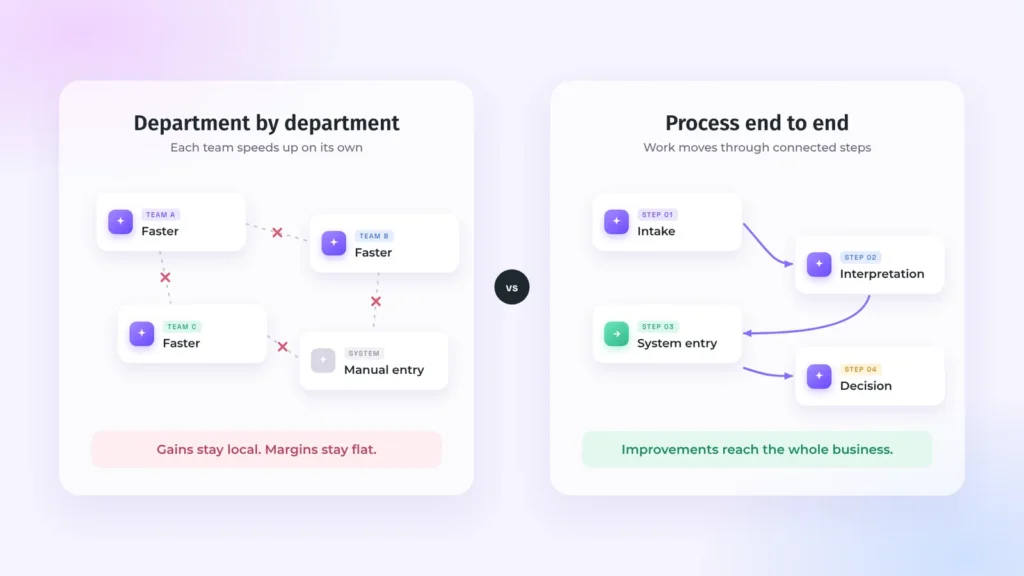
AI isn’t improving profit margins for most companies because it usually improves isolated tasks while the surrounding processes stay unchanged. Extra capacity goes unused, demand outpaces delivery, or automated steps still end in manual data transfer between systems. The gains remain local instead of reaching the bottom line.
Torsten Slok, chief economist at Apollo, looked at the 493 companies in the S&P 500 that remain once the seven largest technology companies are excluded. He found that profit margins and revenue per employee had stayed largely flat, and concluded that AI has delivered “zero financial payoff to corporate America outside of tech”
Most companies begin using AI in a single department or workflow, usually because there’s an obvious task that takes too much time or manual effort. A customer support team automates incoming requests. A finance department uses AI to process documents. A delivery team completes projects much faster than before.
These are meaningful improvements, but every department operates as part of a larger business. In practice, the gains get stuck in three ways:
- Capacity without demand. The delivery team can suddenly handle twice as many projects, but sales keeps bringing in the same amount of work. The company has created capacity but still needs to decide how to use it: serving more customers, reducing costs or developing new services.
- Demand without capacity. Sales generates more opportunities, but delivery can’t keep up.
- Automation that stops at the system boundary. One step of a process is automated, but the information still has to be manually transferred into another system before anything can happen next.
Does AI deliver value if margins stay flat?
Flat margins don’t prove AI isn’t working. They show that improvements haven’t yet translated into financial results across the business. Productivity gains can take time to appear, and they rarely appear at all when only one part of a process changes while everything around it stays the same.
The Apollo numbers are hard to dispute, but they measure company-wide financial outcomes, not whether individual AI applications are useful. In Neurony’s work with clients, one distinction comes up repeatedly: improving an individual activity is not the same as changing how the business operates as a whole.
What does process-level AI transformation look like in practice?
Process-level AI transformation means mapping how work flows across departments and systems before deciding what to build. Instead of giving each department its own AI tool, the company identifies where AI is needed, where conventional software fits better and where connecting existing systems would make the biggest difference.
Neurony’s work with Meesenburg Romania, a distributor of building materials and hardware, shows how this works.
The work started with a Forward Deployed Engineer engagement covering 10 operational areas, including order processing, procurement, inventory, contract administration and customer management. It included discovery sessions with the people responsible for each workflow, an analysis of how each process currently ran, and a final executive report documenting the risks identified and the recommended solutions.
The same patterns appeared across the business. Data already existed, but it was spread across emails, Excel files, the ERP and the knowledge of individual employees. Some workflows required copying information line by line. Shared spreadsheets acted as an operational layer for processes such as backorder management. In several areas, the absence of one key employee could delay or interrupt the work.
That report became the basis for the implementation roadmap, starting with the workflows where the operational need and available data were already clear.
How does AI order processing work with an ERP system?
AI order processing reads incoming orders in any format, extracts products and quantities, and matches them to the internal catalog. An ERP integration then moves validated orders straight into the existing system, so employees don’t re-enter the same data. Without that integration, the AI only automates half the process.
Meesenburg receives customer orders as free-text emails, PDFs, scans, images, handwritten documents, Word files and Excel files. Neurony’s Order Flow application interprets these orders, identifies products and quantities, matches customer descriptions against Meesenburg’s internal catalog, and sends uncertain cases for human review. Validated orders then move directly into the ERP.
According to Meesenburg, the application now automatically processes approximately 50% of the orders received by email, reducing workload and human error in the order processing department.
The ERP connection was built as a reusable integration layer rather than something tied to one application. The same layer can support other workflows that need access to product, customer, stock, order or financial data from the core system.
Related reading: Order processing automation: stop manual entry errors
What can a Forward Deployed Engineer engagement lead to?
A Forward Deployed Engineer engagement maps how work moves across a company’s operations and identifies which improvements are worth building. At Meesenburg, the findings moved into several connected implementations beyond order processing, combining AI, automation, custom software and ERP integration according to the needs of each workflow.
These included:
- Mees AI for procurement planning. Purchasing decisions had relied heavily on individual judgment. Mees AI brings stock, sales and orders already in progress into the replenishment calculation and suggests the required purchase quantity, while the final decision stays with the user.
- A Contract Generator. Client data stored in Excel previously had to be copied into individual contract templates. The web-based generator builds contracts from structured client data, validates mandatory fields and exports single or bulk PDFs for review.
- A connected backorder workflow. Backorders were tracked in a shared Excel file outside the ERP, with limited traceability and editing conflicts. A connected workflow, currently in development, brings missing products into the application as outstanding items and checks stock availability so records update when products arrive.
Does every improvement in an AI transformation need AI?
No. Many operational improvements come from conventional software or better system integration rather than AI. AI is most useful for interpreting information that would otherwise need human attention, while integrations and conventional applications make that information usable across the business. The value comes from how these pieces work together.
At Meesenburg, the FDE analysis mapped where AI could add value and where a process first needed better data, clearer rules or stronger system connections. Where a process wasn’t ready for AI, the first step was improving the underlying data flow or integration. Once those gaps were addressed, AI could be introduced into workflows such as order interpretation, product matching and procurement planning.
The ERP integration layer and the Contract Generator solve real operational problems without depending on AI. The reusable integration also means each new workflow doesn’t need its own system connection built from scratch, which makes it easier to extend automation into more areas of the business.
How should companies measure AI ROI?
Companies should measure AI ROI against the specific business problem the AI was meant to solve. Handling higher order volumes, reducing operational errors, improving inventory decisions and reducing dependence on individual employees are different objectives, and each needs its own success measure defined before anything is built.
Companies often underestimate how much management judgment is required after a promising AI use case has been identified. The technical question of whether something can be automated is usually easier to answer than the business question of whether automating it is worth the investment.
Before measuring results, a company needs to understand what problem it’s solving, how that problem affects other activities and what would actually improve if it disappeared. Those answers should shape both what gets built and how success is measured. A clear AI integration strategy helps set those objectives before the first build.
Slok also observed that AI may be a great calculator, but intelligence in business is largely about judgment. That holds true in practice. Choosing the right model matters, but understanding which processes are worth changing, how they connect to the rest of the business and where to invest next matters at least as much.
Where should a company start with AI to see financial results?
Start by tracing how one important piece of work moves through the business, from the moment it enters until the intended result is delivered. Identify friction, duplicated data entry and decisions based on incomplete information, then decide which problems AI can solve and which need a different fix.
A useful starting point is not asking which departments could use an AI agent or which employees need another tool. Instead, follow the work and ask:
- Which activities create the most friction?
- Where is information entered or copied more than once?
- Which decisions depend on incomplete data?
- Do the existing systems support the way people actually work?
Once those problems are visible, it becomes easier to decide which ones AI can realistically solve and which need something else. It’s also easier to prioritize by business importance rather than by how impressive the technology looks in a demo.
For a structured starting point, Neurony’s AI Readiness Assessment helps identify where your organization stands and which opportunities are worth pursuing first.
The question every company investing in AI should ask
Is the company implementing technology wherever it finds an opportunity, or making deliberate changes to how the business operates?
The return on AI depends less on how many applications a company implements and more on whether those applications help it operate differently.
Not sure where AI would make a real difference in your business? Start with the AI Readiness Assessment, or talk to us about a Forward Deployed Engineer engagement.