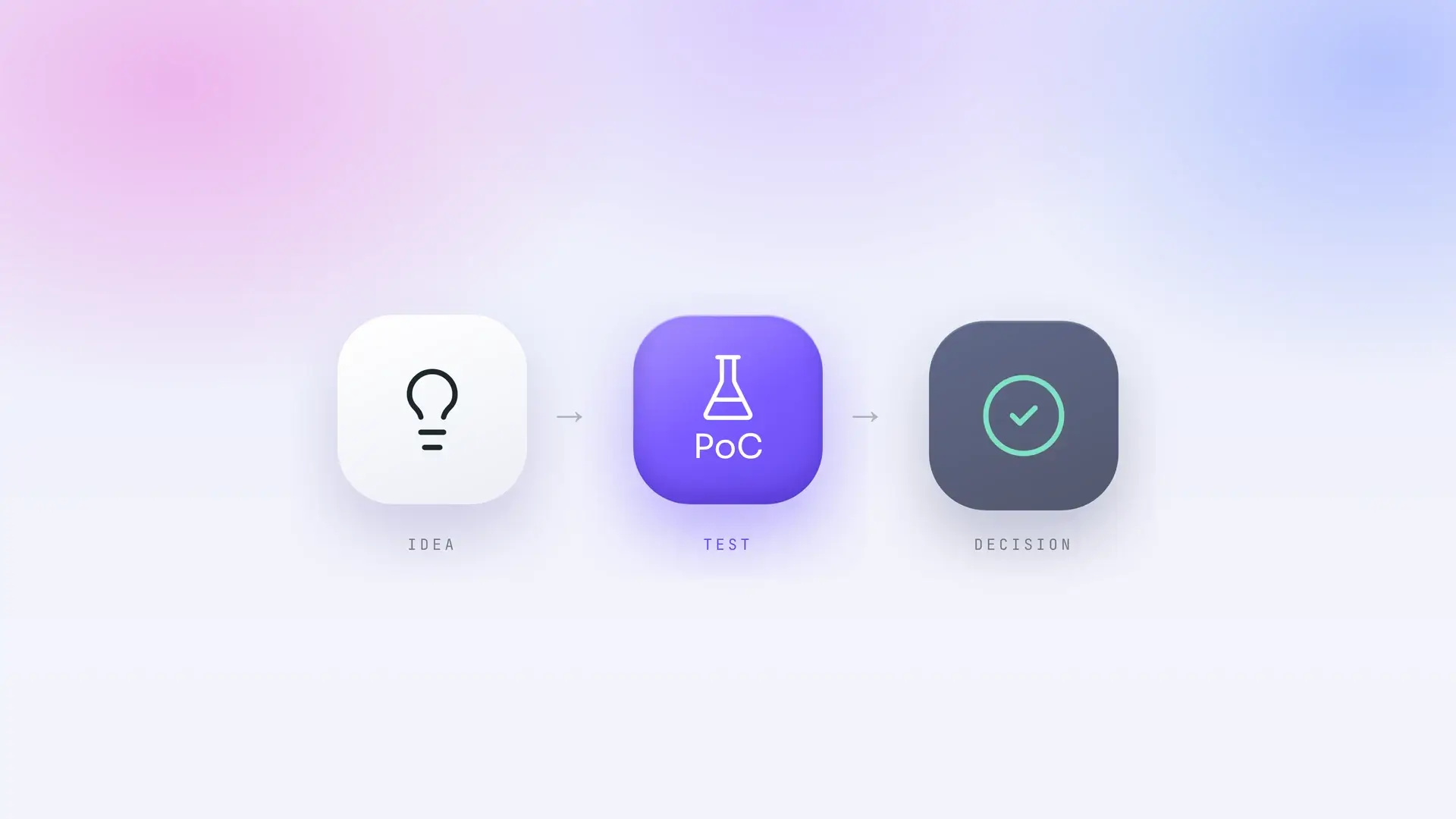








An AI proof of concept (PoC) is a simplified version of a working system, built in a fixed time to test one AI use case before you commit to a full build. It is for operations, IT and digital leaders who have an idea worth testing and don’t want to fund a full implementation on a guess. This guide covers why a PoC is worth running, when to run one, what goes into it, and examples from Neurony’s own projects.
Key takeaways
- An AI proof of concept (PoC) is a simplified working system that tests one AI use case before a company funds a full build.
- A PoC is worth running when the data, the integration or the business value is still uncertain. If the approach is proven and the risk is low, the build can start directly.
- A useful PoC settles six things: scope, data and system access, success criteria, human review, timeline and the decision.
- A PoC should end in one of three decisions: build, adjust and retest, or stop.
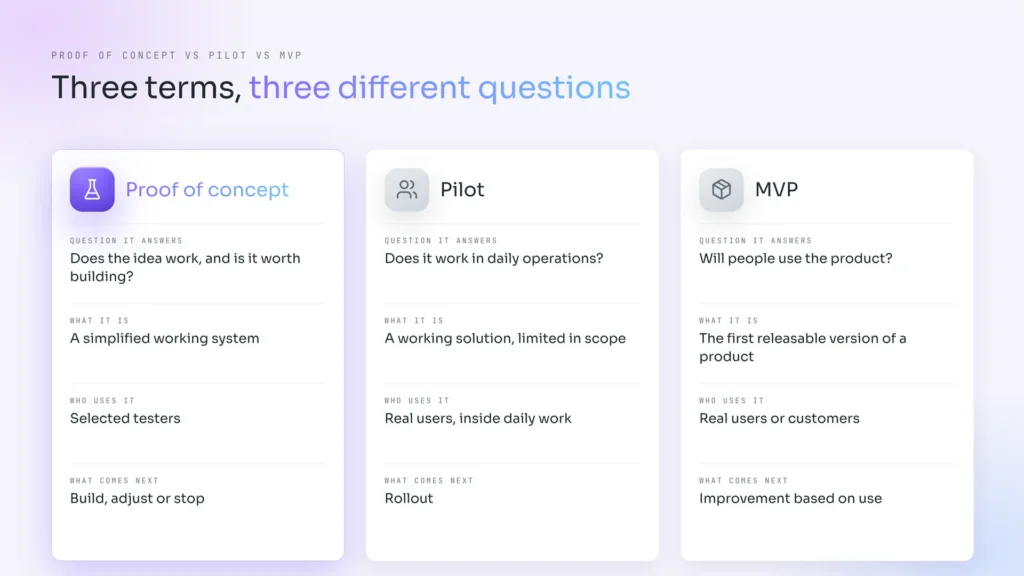
- A PoC is not a pilot or an MVP. The usual order is PoC, then pilot, then rollout.
- At Neurony, a scoped proof of concept may typically be delivered in approximately 14–21 days, depending on data access, integrations, technical complexity, and client availability. Each PoC is scoped and priced individually, and the system built belongs to the client.
- Neurony’s PoC examples include a technician assistant for Mateco and order processing automation for Meesenburg, where 98% of processed orders required no manual modification.
Why do you need an AI proof of concept?
Most companies don’t need to be convinced that AI could help them. What they need is a way to find out whether one specific idea works on their own data, in their own process, before they sign off on a full implementation budget.
A generic demo can’t tell you that. AI models behave differently on polished examples than on the emails, PDFs, manuals and system exports a business actually runs on. A proof of concept tests the idea on inputs that represent your own: real data where that is agreed, or samples you provide.
The output is a system your team can actually use and test, rather than a slide deck, and a decision: build it properly, adjust it and test again, or stop. That decision is the point. A PoC that ends with “interesting, let’s keep exploring” has not done its job.
It also keeps the cost of being wrong small. If the data can’t support the approach, you find out after a few weeks of work instead of after a full rollout.
When should you run an AI proof of concept?
A PoC earns its place when something important is still uncertain:
- The data is uncertain. You don’t yet know whether the inputs are consistent enough for AI to handle reliably, for example orders that arrive in several formats from different customers.
- The integration is uncertain. The idea depends on reading from one system and writing into another, and nobody has confirmed it can be done cleanly.
- The business value is uncertain. Leadership needs evidence against a real baseline before committing budget.
- A previous pilot stalled. A smaller, tightly scoped test shows whether the idea or the earlier execution was the problem.
If the approach is already proven and the risk is low, you can skip the PoC and start the build directly.
The anatomy of an AI proof of concept
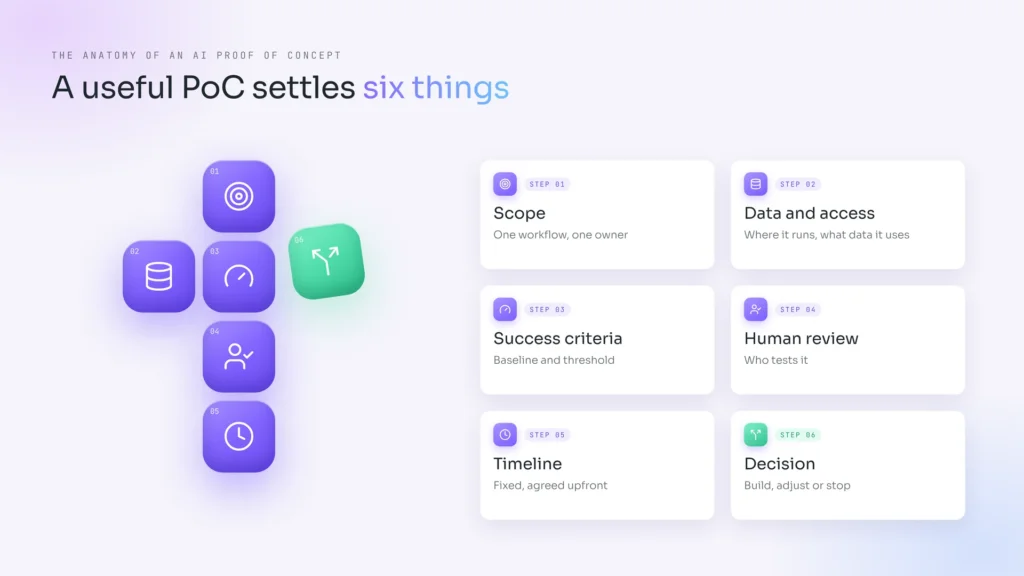
No two proofs of concept look the same. Each one is scoped individually, based on what you need to prove, and starts once the working agreement is in place. The system built during the PoC belongs to you. Whatever the specifics, a useful PoC settles six things.
Scope
One workflow, with one named owner who knows the process and can make the call at the end. Testing one document type from one channel is a contained piece of work. Testing every document type from every channel at once is a project.
A PoC is also not a small version of the finished product. It doesn’t need to handle every edge case, carry production-level monitoring, or connect to every system the final version will touch. Trying to prove all of that in a few weeks turns a test into a slow, underfunded implementation.
Data and system access
Two questions get agreed early: where the PoC runs and what data it uses. A PoC can run on your servers or in your partner’s environment. It can work with your real data or with samples you provide. The right choice depends on what the test has to prove and how sensitive the data is.
Whichever setup you choose, decide who provides which files, exports or credentials, and by when. If the PoC needs data from an ERP or CRM and nobody has confirmed who can provide it, that question alone can take longer than the build.
Success criteria
A good PoC answers three questions, in this order:
- Can it be done with your kind of data? The approach has to work on inputs that look like your real ones, including the messy ones.
- Does it move the metric you care about? Pick one measure and record today’s baseline. For an order-processing workflow, that might be the share of orders entered without manual correction. Then set the threshold that would justify a full build.
- Does it fit the way the work is done? A model can be accurate and still fail if the output lands in the wrong place, at the wrong time, or in a format nobody trusts.
Without a baseline and a threshold agreed upfront, the result becomes a matter of opinion.
Human review
Who tests the PoC, and how, is part of the agreement. Usually your team receives the system and tries it out on their everyday tasks.
Plan that time on your side, or the PoC stalls in its final week. Testers check outputs against what they expect, and the results feed the decision. It also helps to decide in advance which cases would always go to a person, even after rollout.
Timeline
A scoped proof of concept may typically be delivered in approximately 14–21 days, depending on data access, integrations, technical complexity, and client availability.
Those four dependencies are where timelines slip. Reading from one system is simpler than reading from one and writing into another. Extracting fields from a standard document is a different task from interpreting free-text emails in several formats. And a PoC run without the process owner’s time tends to prove the wrong thing.
The decision
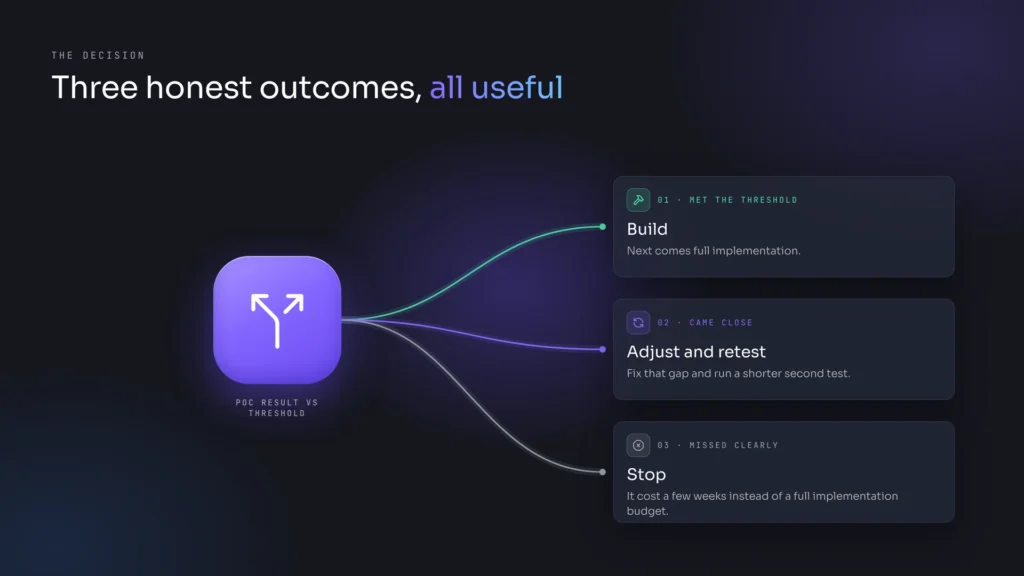
Set the decision date before you start. There are three honest outcomes, and all three are useful:
- Build. The result met the threshold. Next comes full implementation: connecting the remaining systems, handling exceptions, adding monitoring, and putting it into daily use.
- Adjust and retest. The result came close. Usually the gap is in the data, the scope or the review step rather than the idea itself. Fix that gap and run a shorter second test.
- Stop. The result missed clearly. It cost a few weeks instead of a full implementation budget, and the team now knows why that approach doesn’t fit.
In practice, a PoC is rarely a single round. Once your team has used the first version, new requirements come up, and a refined second round follows before the full rollout. The setup can change at this point too, for example moving from the partner’s environment into your own infrastructure.
What you need to provide
A PoC moves at the pace of the inputs on your side. Before it starts, have these ready:
- A process owner. One person who knows the workflow, answers questions during the test and makes the call at the end.
- Data or samples. Real data, or sample files such as orders, documents or manuals, depending on what was agreed, and a named person who provides them by a set date.
- System access. If the PoC reads from or writes into your ERP, CRM or other tools, the exports or credentials it needs.
- Testers with time set aside. The people who will try the system on their everyday tasks, with room in their week to do it.
- A baseline and a decision date. Today’s number for the metric you chose, and the date you will decide to build, adjust or stop.
How much does an AI proof of concept cost?
Each PoC is scoped and priced individually. The price depends on the same factors as the timeline: how narrow the scope is, how many systems are involved, how ready the data is, and how much review time your team can give. The most expensive PoC is the one that tests something nobody was ready to act on.
Proof of concept vs pilot vs MVP
The three terms are often used as if they mean the same thing. They don’t.
AI proof of concept examples
Most AI proofs of concept fall into a handful of types. For each one below: what the PoC tests, a typical setup, and the go/no-go criteria to agree before it starts. Where Neurony has run one, the project sits under its type.
1. Customer support assistant
What the PoC tests: Whether an AI assistant can answer repetitive support questions correctly from your own help articles, policies and past tickets.
Typical setup: Connect the assistant to a defined set of help articles and a sample of past tickets, then run it on real questions for the test window. Track how many questions it resolves without a person and how many answers are correct.
Go/no-go criteria: It resolves the share of questions agreed upfront, and it never states a policy that isn’t in your documentation. Questions it can’t answer go to a person.
2. Document and data extraction
What the PoC tests: Whether AI can read the documents your team processes by hand, such as orders, contracts, IDs or forms, and pull out the fields your systems need.
Typical setup: Run a batch of real documents, including the messy ones (scans, photos, different layouts), through the extraction and compare the results with what a person entered for the same documents.
Go/no-go criteria: Field accuracy reaches the threshold agreed upfront, and anything the system isn’t sure about goes to a person instead of straight into the ERP.
AI order processing automation for Meesenburg
Use case: Orders arriving by email and as documents were read and typed into Meesenburg’s ERP by hand.
What was tested: Whether the orders could be read and entered automatically. The automated process started as a pilot on Meesenburg’s incoming orders.
What happened next: The process moved into production. In the Meesenburg implementation, 98% of processed orders required no manual modification. Read the full story in order processing automation and the Meesenburg case study.
AI document verification for an online car insurance broker
Use case: For transfer policies, an operator cross-checked each customer’s ID card, registration certificate and other documents against the order by hand, at an average of 15 minutes per policy, and only during working hours.
What was tested: Whether AI could identify each document type, straighten rotated photos and extract the required fields, while a separate set of rules checks the extracted data against the order.
What happened next: The system has been live since October 2026. Policies that pass the checks are issued in about 5 seconds, and over 50% of the orders that were checked manually now issue automatically. Unusable orders dropped from 10% to 2%. The broker is not named at its request.
3. Defect detection with computer vision
What the PoC tests: Whether an image model can spot defects in products or components as well as, or better than, manual inspection.
Typical setup: Use a controlled set of labelled photos, with both defective and good parts, taken in the conditions of the real production line.
Go/no-go criteria: Missed defects and false alarms both stay below the error rate of manual inspection.
4. Predictive maintenance
What the PoC tests: Whether sensor data, such as vibration, temperature or pressure, can flag equipment failures before they happen.
Typical setup: Take a historical window of sensor logs that includes known failures. The first check is whether the data is clean and the failures are actually recorded.
Go/no-go criteria: The model flags past failures early enough to act on, with few enough false alarms that the maintenance team will trust it.
5. Internal knowledge assistant
What the PoC tests: Whether an AI assistant can answer employees’ questions from internal documentation, with sources, and respect who is allowed to see what.
Typical setup: Load a defined set of manuals, procedures or policies, and have the people who use them every day test the assistant on their real questions.
Go/no-go criteria: Answers are correct and cite their source, and no one sees content outside their access rights.
AI knowledge assistant for Mateco’s service technicians
Use case: Mateco’s service technicians needed answers from service, operator and parts manuals for many machines and versions. The fastest route was often a call to a senior technician.
What was tested: The PoC ran in our environment, using sample manuals that Mateco provided. Specific technicians chosen by Mateco tested the assistant and tried it in their work.
What happened next: The feedback led to a refined second round. The assistant is now deployed in Mateco’s own infrastructure and connected to its service app.
Ready to find the right thing to test?
A proof of concept is only as good as the use case behind it. Book a call and we’ll look at how your team works today, and where a first test would pay off.
Ready to explore how this applies to your business?
Schedule a meeting with our team to discuss your goals and next steps.
Schedule a meeting