







Most AI initiatives never make it past the pilot. This roadmap shows how to turn promising ideas into reliable systems with measurable business impact.
Artificial intelligence is changing how companies process information, coordinate operations, serve customers, and make decisions. For many mid-market organizations, however, the main challenge is no longer recognizing that AI matters.
The challenge is knowing where to begin.
Leaders are under pressure to increase speed, reduce operational friction, control costs, and manage growing complexity. They can see potential applications for AI across operations, finance, customer service, reporting, administration, and internal knowledge. But the path from interest to implementation often remains unclear.
Which use case should come first? Is the available data good enough? Can AI connect to the systems already in place? Will employees trust it? How much will implementation cost? And how will the company know whether the initiative has created real value?
Successful AI adoption does not begin with selecting a tool. It begins with identifying a meaningful business problem, understanding whether the organization is ready to address it, and building a realistic path from experimentation to everyday use.
This AI adoption roadmap explains how to assess readiness, identify valuable opportunities, select the right workflow, validate a focused use case, move from pilot to production, and scale AI without creating unnecessary operational disruption.
What AI Adoption Actually Means
AI adoption is often confused with two things it isn’t.
It isn’t the same as employees using AI tools on their own. A company can have half its staff using ChatGPT for drafts and summaries and still have implemented nothing structurally — no process has changed, no one owns an outcome, nothing is being measured. That’s useful, but it’s individual habit, not organizational adoption.
It also isn’t the same as a working prototype. A demo that reads invoices correctly, or a chatbot that answers questions in a controlled test, proves the technology works. It doesn’t prove the organization has adopted anything, that only happens once the result is running inside a real workflow, with a person accountable for it, months after the excitement of the pilot has worn off.
AI adoption is what happens in between those two things: a specific business problem, connected to a specific AI solution, running inside how the company actually operates, with someone who owns whether it keeps working.
In practice, that means the solution:
- Addresses a problem that was clearly defined before any technology was chosen
- Works with the organization’s real data, not a clean sample
- Fits inside an existing workflow rather than sitting beside it
- Includes human oversight appropriate to the risk involved
- Has one named owner, not a project team that disperses after launch
- Produces results that are measured against a baseline that existed before the AI did
It’s worth separating two words that get used interchangeably. Implementation is the technical work of building and deploying the solution — the integration, the model, the interface. Adoption is the organizational layer around it: whether people trust it, whether it has an owner, whether the business changed how it works because of it. A company can implement something and never adopt it — that’s most of the AI pilots that quietly stop getting used six months after launch.
This roadmap covers the adoption side: the readiness, the decision-making, the ownership, and the governance that determine whether an implementation actually sticks. Depending on where you’re starting from, that path runs through one or more of six specific engagements — from a five-minute readiness check through to a live, monitored system in production, covered stage by stage below.
The most valuable outcome is rarely the most advanced one. It’s the one that solves an important problem reliably enough to change how the business actually runs.
Why AI Adoption Stalls
Most companies that experiment with AI do not fail to build something. They fail to keep it in use.
A pilot launches, attracts attention, and works reasonably well for a few weeks. Six months later, however, no one is quite sure whether it is still running, and the team has returned to doing the work manually.
This pattern is common enough to name directly.
No one owns the system after launch
Leadership may be enthusiastic and the technical implementation may be sound, but there is often no one whose day-to-day responsibility depends on whether the system continues to perform.
When it produces an unexpected result in week three, no one is clearly responsible for noticing, investigating, or correcting it.
Executive support at the top and technical capability at the bottom are not enough. Without clear operational ownership in between, the system is likely to lose momentum and quietly fall out of use.
Success was never defined before implementation
Without a baseline, there is no reliable way to show whether the system is improving performance.
Teams may believe that the solution is saving time or reducing effort, but when budgets are reviewed, those beliefs are difficult to defend without evidence.
The organization ends up defending an impression rather than a measurable result.
Success criteria should therefore be defined before the pilot begins. These may include processing time, error rates, manual intervention, response speed, capacity, cost, or another metric tied directly to the business problem.
The solution was treated as a project with an end date
Many AI initiatives are managed as temporary projects.
Once the system goes live, the delivery team moves on to the next priority. No one remains responsible for monitoring performance, updating the solution as the business changes, or handling the exceptions that appear after launch.
AI adoption requires ongoing ownership.
The solution must be reviewed, maintained, and adjusted as workflows, data, systems, and user expectations evolve.
Trust erodes one poor result at a time
Trust rarely disappears because of one dramatic failure.
It usually declines gradually.
An employee receives an incorrect or confusing result and has no clear way to report it. The next time, they double-check the system manually. Eventually, they return to the old process because it feels more predictable.
Usage often declines long before anyone formally decides to stop using the solution.
This is why employees need:
- A clear way to report problems
- Guidance on when outputs should be reviewed
- Visibility into how issues are resolved
- Confidence that feedback leads to improvements
The first success never becomes a repeatable capability
One team may achieve a meaningful result, but the organization has no lightweight way to apply the same approach elsewhere.
The knowledge remains inside one project. The reasoning behind the use case is not documented, the technical patterns are not reused, and the governance process must be reinvented each time.
The company ends up with an isolated AI solution rather than a repeatable method for identifying, testing, and scaling new opportunities.
None of these are primarily technology problems.
They are the reason this roadmap gives readiness, ownership, measurement, and governance the same importance as the pilot itself.
Building a working demonstration is often the easier part. Creating the conditions that keep it useful is what determines whether AI becomes part of the business.
A Step-by-Step AI Adoption Roadmap
1. Begin With a One Business Goal That Directly Improves Performance
The most succesfull AI adoptions start with clarity about the problem the organization wants to solve. Leaders who successfully adopt AI rarely begin by selecting tools or platforms. Instead, they focus on identifying where friction slows the business down and where improvement would have a meaningful impact.
These friction points usually appear in processes where work is repeated frequently. They appear in coordination tasks where information is passed between departments. They appear in workflows that involve data entry, review, or validation. They appear in communication patterns that expand as teams grow and as customer expectations increase.
A meaningful AI adoption strategy begins by answering a few essential questions.
• Where does the organization lose time because of manual steps?
• Which processes contribute to errors or rework?
• Which handoffs cause delays that customers feel directly?
• Where does volume increase create operational pressure?
• What tasks require skilled employees to spend time on low-value work?
These questions bring clarity to where AI can create the strongest return. When the starting point is a problem that has a visible impact on performance, every decision becomes easier. Leaders understand the purpose of the initiative, and teams understand why change is needed.
For many companies, the first opportunity appears in areas such as processing documents, preparing reports, organizing requests, routing communication, validating information, or consolidating data from multiple systems. These workflows contain predictable patterns that AI can understand and support without disrupting the core operations of the company.
Identify the AI Opportunities Worth Pursuing
When several operational problems compete for attention, choosing the right starting point can be difficult. One process may consume significant employee time but offer limited financial value. Another may appear suitable for automation but depend on inaccessible data, complex integrations, or decisions that carry too much risk.
Neurony’s AI Worth Doing workshop helps business, operational, technical, and compliance stakeholders evaluate potential AI use cases together during a focused four-hour working session.
Each opportunity is considered against factors such as:
- The business problem it addresses
- Its expected operational or financial value
- The availability and quality of the required data
- The systems and integrations involved
- The level of technical complexity
- The need for human oversight
- Security, legal, or compliance concerns
- The organization’s ability to implement and own the solution
The objective is not to generate the longest possible list of AI ideas. It is to narrow the list to a small number of opportunities that are valuable enough to matter, feasible enough to investigate, and clear enough to support a practical next step.
You leave with:
- Three to five prioritized AI opportunities
- Clarity on which ideas are worth investigating
- Early visibility into technical and compliance risks
- Alignment around the most practical next step
Explore the AI Worth Doing Workshop
2. Understand How Data Moves Through the Organization
A successful AI adoption strategy requires a clear understanding of how information flows through the business. Many leaders believe that AI cannot begin until all data is clean, centralized, and standardized. This belief comes from the experience of earlier digital transformation initiatives that depended on highly structured data. Modern AI does not require this level of preparation to begin producing value.
Today’s models can interpret information contained in emails, documents, spreadsheets, scanned forms, and free-text fields. They can recognize patterns across unstructured sources and organize information without requiring the company to restructure its entire system.
What matters more is an understanding of where the data originates, how teams use it, and where inconsistencies appear. When leaders gain this visibility, they discover that their company often has more usable data than they realized.
Mapping data flows provides several benefits.
• It reveals which workflows are ready for AI today.
• It highlights small adjustments that can significantly increase reliability.
• It shows where interventions in structure or documentation are helpful.
• It prepares the organization for multi-step automation.
• It reduces uncertainty about how AI will behave within existing systems.
A thoughtful examination of data movement ensures that the AI implementation is connected to reality rather than assumptions. This is one of the reasons mid-market companies benefit from a structured assessment before beginning any technical work. It sets the foundation for predictable results later.
Assess Whether Your Organization Is Ready for AI
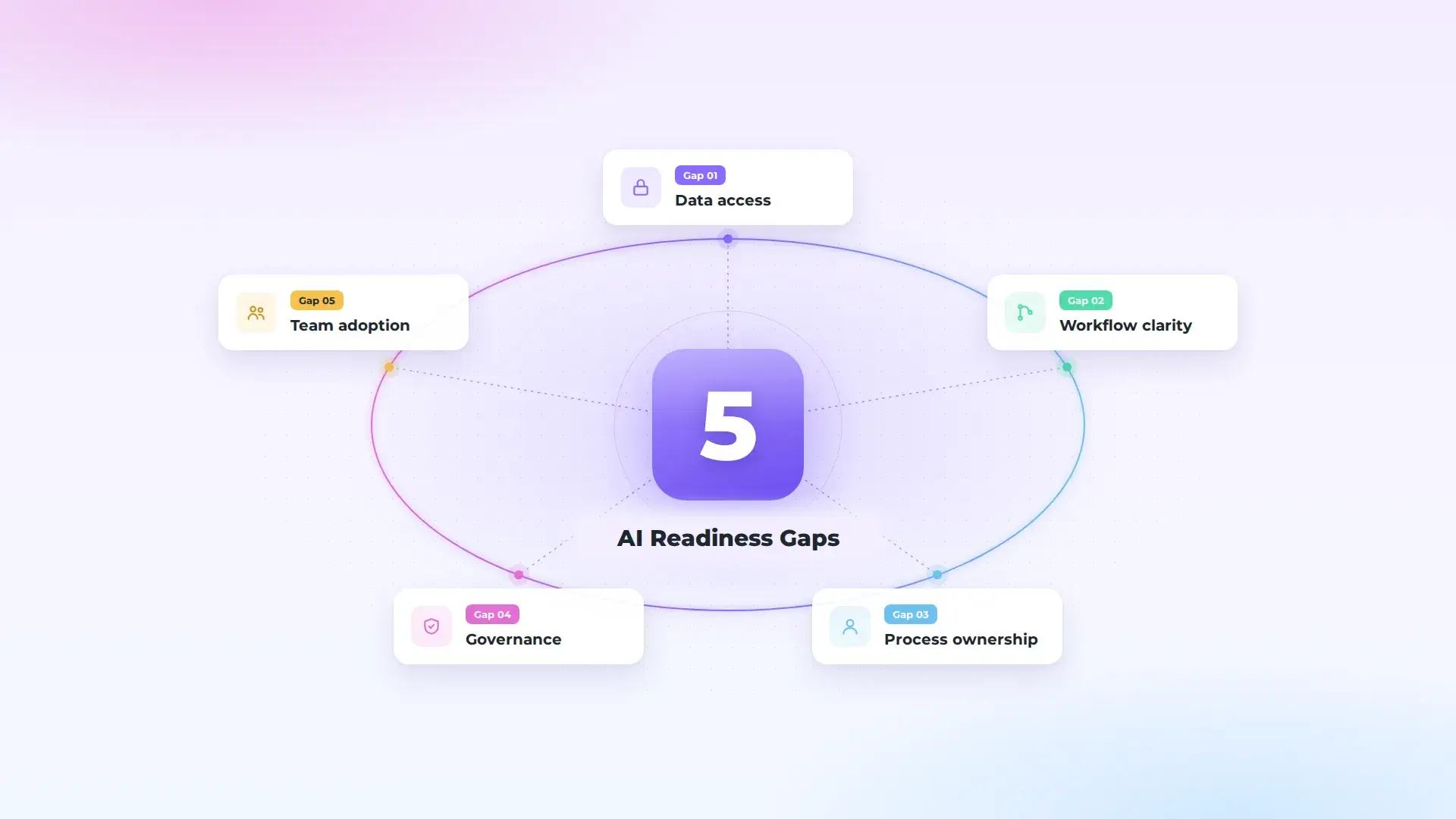
Understanding data flow is only one part of AI readiness. A successful implementation also depends on process clarity, system accessibility, internal ownership, governance, and the organization’s ability to support change.
Neurony’s AI Readiness Assessment helps evaluate these conditions before the company commits to technical work.
The assessment considers:
- Business priorities and strategic alignment
- Process and workflow readiness
- Data availability and accessibility
- Technology and integration conditions
- Internal ownership and skills
- Governance and risk considerations
The guided questionnaire provides an initial view of the organization’s strengths, readiness gaps, and practical next steps. It can help clarify whether the company is ready to move forward, which areas require further preparation, and what kind of engagement may be most appropriate.
Start the AI Readiness Assessment
3. Select One Workflow and Build a Focused AI Use Case
AI adoption becomes more manageable when the organization begins with a single workflow. This approach reduces risk and allows the company to learn gradually. The first use case should be important enough to demonstrate value but contained enough to avoid complexity.
Many successful projects begin in operations, administration, customer communication, or reporting. These areas often require employees to gather information, process documents, categorize requests, or prepare summaries. They involve repeated steps that AI can support effectively.
A focused use case provides several advantages. It allows leaders to evaluate AI performance in a controlled environment. It helps employees see the system as a support tool rather than a threat to their responsibilities. It creates measurable outcomes that reinforce confidence and guide future decisions.
In one example, a company in the environmental services sector had a workflow where incoming vehicles had to be processed, documented, and registered in the internal system. This task took considerable time because the process involved manual data entry, information verification, and coordination between departments. After introducing AI support, the workflow became significantly faster and more reliable. Employees experienced less pressure during peak periods, and the company gained more consistent operational data. The improvement was meaningful not because of the technology itself, but because it addressed an operational burden that had existed for years.
This type of early win strengthens internal support and helps the organization understand where to go next.
Neurony worked with Meesenburg on an email order automation workflow. Incoming orders had to be interpreted, mapped, validated, and transferred into the operational system.
Of the 1,426 orders processed during the initial measured period, 98.28% required no manual modification. As the system matured, approximately 75–80% of monthly product mappings were completed fully or partially automatically, with manual intervention approaching zero.
The value did not come from introducing AI in isolation. It came from applying AI to a repetitive operational bottleneck with a clear baseline and measurable outcome.
Turn a Selected Workflow Into an Implementation Roadmap
Once a promising workflow has been identified, the next challenge is understanding how it operates in practice.
The documented process may not reflect how work is actually completed. Important exceptions may exist only in employees’ experience, and the workflow may depend on several systems, manual checks, or informal handoffs.
Neurony’s Forward Deployed Engineer engagement brings an engineer close to the real operational environment to work with the people who understand the process best.
The engagement can help the organization:
- Map the current workflow and its dependencies
- Understand how data moves between systems
- Identify undocumented process knowledge
- Clarify integration requirements
- Surface technical and operational constraints
- Evaluate where AI can create measurable value
- Define a realistic path toward a proof of concept or implementation
This is particularly useful when the selected process crosses several teams or systems, relies heavily on employee knowledge, or requires engineering input before the company can make a responsible development decision.
Explore the Forward Deployed Engineer
4. Integrate the Pilot Into Daily Operations
A pilot creates lasting value only when it becomes part of everyday work — not when the test succeeds once, but when nobody has to think twice about relying on it.
A technically successful result isn’t enough on its own. The workflow around it has to be just as clear: someone owns it, responsibilities are assigned, and employees know what to do both on a normal day and when something doesn’t fit the pattern.
That means settling a short list of questions before the pilot becomes routine — who owns the system once it’s no longer new, who’s watching its performance, which outputs need a person to sign off before they take effect, how exceptions get handled, how someone reports a result that looks wrong, how changes to the workflow or the underlying business rules get reflected, and what happens if performance starts slipping.
Employees need time to adapt, and that starts with being told plainly what the system does, what it doesn’t do, which parts of the job are still theirs, when their judgment overrides it, and where to send feedback when something’s off.
Human oversight works best designed into the workflow from the start, not bolted on afterward. The strongest operational systems pair the speed and consistency of AI with human judgment exactly where context, accountability, or risk calls for it — not everywhere, and not nowhere.
The goal is a system reliable enough that employees fold it into how they already work, rather than quietly keeping a manual backup running alongside it just in case. it into their normal way of working without maintaining a parallel manual process.
5. Expand Only After the First Workflow Becomes Repeatable
Scaling AI becomes realistic once the first workflow performs reliably and the organization understands why it works.
Before introducing AI into additional processes, confirm that:
- The system is producing stable results
- Employees are using it consistently
- Ownership is clear
- Exceptions are handled effectively
- Performance is being monitored
- Governance requirements are defined
- The business value has been measured
- The technical approach can be reused
The organization can then document a lightweight internal method for future initiatives.
This may include:
- Criteria for selecting use cases
- A standard readiness checklist
- Documentation requirements
- Data-access rules
- Human-review guidelines
- Success metrics
- Governance checkpoints
- Reusable integration patterns
These standards do not need to become a complex corporate program. Their purpose is to preserve what the organization has learned and make each new implementation easier to evaluate and deliver.
When companies scale through evidence and learning, AI adoption becomes more controlled and predictable. Each successful workflow strengthens internal capability, reduces uncertainty, and creates a clearer foundation for the next opportunity.
Over time, AI becomes less of a separate innovation initiative and more of a practical capability embedded in how the organization operates.
Build a Repeatable Approach to AI Adoption
Once the first implementation is stable and its value is measurable, the organization can begin applying the same discipline to additional workflows.
Neurony’s AI Adoption approach helps companies move from isolated projects toward a repeatable capability by establishing:
- Criteria for identifying and prioritizing future use cases
- Reusable technical and integration patterns
- Governance and human-review standards
- Performance and value-measurement practices
- Clear ownership across the adoption lifecycle
- A roadmap for scaling successful solutions
This allows the organization to expand AI through evidence and learning rather than through disconnected experiments.