







A readiness score tells you where you stand. It does not tell anyone what to do on Monday morning. The companies that get real use out of an AI readiness assessment treat the report as the first draft of a plan. They pick one starting point, name one person to own it, and set a short, fixed window to prove whether it works. The ones that don’t usually file the report, agree it was interesting, and come back to it six months later with the same findings.
This article covers how to read your results in a useful order, how the weakest part of your score should shape your first steps, and what a realistic first 90 days can look like. There is an example roadmap near the end you can adapt.
Your AI readiness report has arrived, with a score out of 100, five dimension scores, and a list of recommended next steps. The harder question is who does what first, and by when.
In our view, the report is most useful when it becomes the first draft of a short plan: one starting point, one owner, and a fixed window to find out whether the idea works. Below is how to read your results in a practical order, how your weakest score should shape the first month, and an example of what the first 90 days can look like.
What Your Assessment Actually Gives You
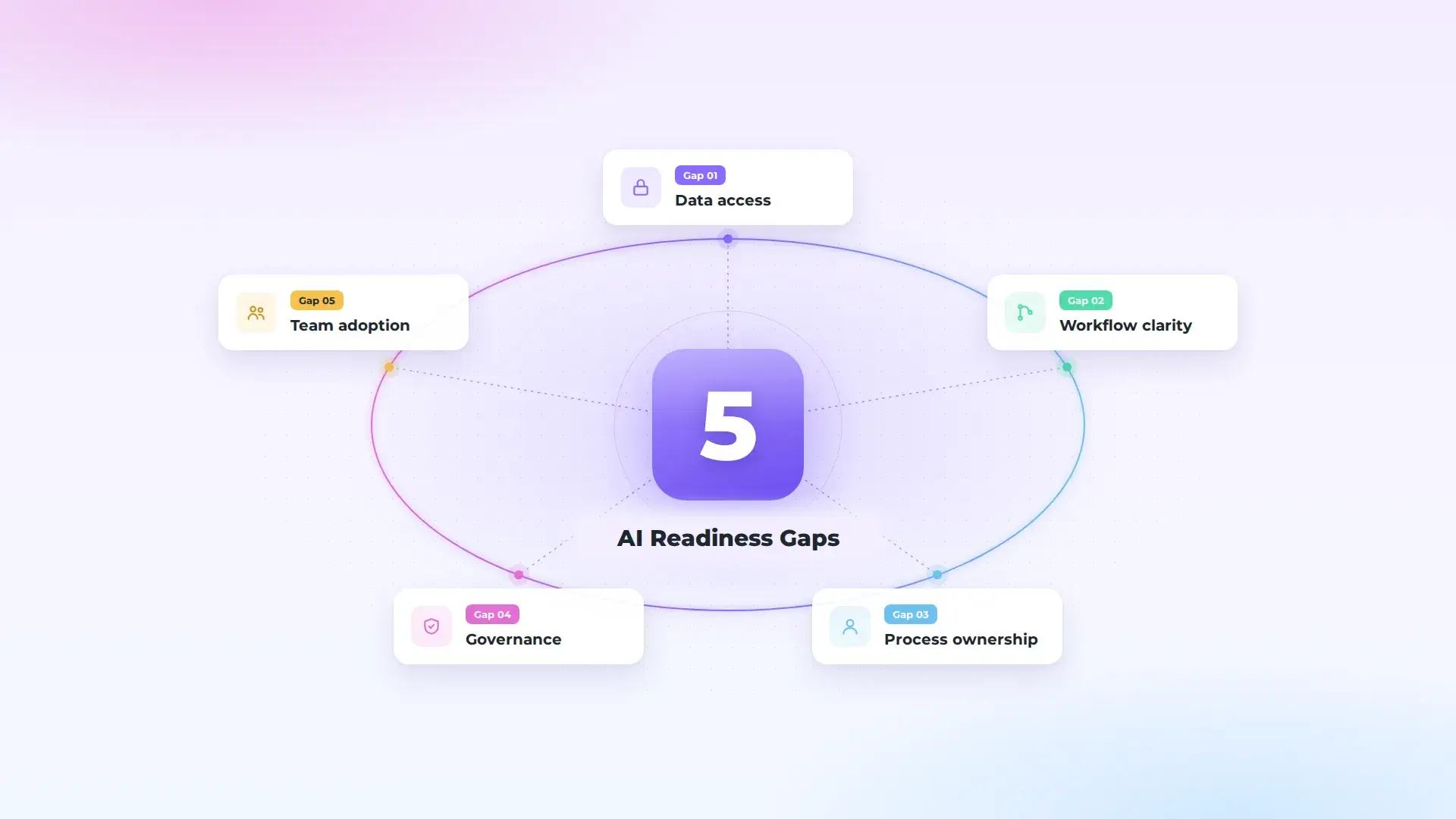
Neurony’s AI Readiness Assessment returns an overall score out of 100, a score for each of five dimensions (Strategy Clarity, Leadership Readiness, Process Visibility, Data & Systems, and People & Skills), an executive summary, the biggest opportunity it found, and recommended next steps. If you assessed several departments, the findings are broken down by department. Every report is reviewed by a human expert and sent within 24 hours. For a full breakdown of each dimension, see What Is an AI Readiness Assessment? How It Works, What It Measures, and What You Get.
For planning, the overall number is the least useful part. Two companies can both score 58 for completely different reasons. One has clean, accessible data and nobody willing to own an AI project. The other has an eager sponsor and a core workflow that has never been written down, so their first 90 days should look nothing alike.
Read the Report in This Order
1. Start with the biggest opportunity. This is where your first effort should land. It names a department and usually a specific workflow, which gives you far more to act on than a company-wide number.
2. Then look at the lowest dimension score in that same department. This is your blocker. A weak score in a department you are not starting with can wait until you get there. If you try to raise every low score before doing anything, the plan becomes a list of improvement projects with no finish line.
3. Then read the recommended next steps. Use them as the starting list, and cut anything that does not serve the opportunity you picked in step one.
What Your Weakest Dimension Tells You to Do First
Your lowest relevant score decides what the first 30 days are for.
- Strategy Clarity: write down the business problem and the metric you would use to judge improvement. Until that metric exists, testing a tool will not tell you much.
- Leadership Readiness: name one owner who has both the authority and the hours to make decisions. A test can succeed technically and still stall the moment it needs someone to change how a team works.
- Process Visibility: document the workflow the way it really runs, including the exceptions people handle from memory, because AI built on the official version of a process will meet the unofficial one on day one.
- Data & Systems: get access to the specific systems this one workflow depends on. That is a much smaller job than a company-wide data project, and it often starts with a single conversation with IT or your ERP vendor.
- People & Skills: involve the people who will use the solution from the first week and agree how they will check and correct its output.
Start With One Workflow in One Department
A 90-day plan holds together when it is built around one workflow in one department. Plans that try to cover AI across the whole business in a single quarter tend to spread attention too thin to prove anything.
The longer path, including why the first workflow should become repeatable before you expand, is covered in The AI Adoption Roadmap: A Practical Blueprint From Readiness to Results. The 90 days below are its opening stretch.
An Example 90-Day Roadmap
This is an illustrative scenario, not a client case.
A distribution company of around 120 people assesses Operations and Finance. The biggest opportunity sits in Operations: customer orders arrive by email and are re-typed into the ERP by hand. The lowest relevant score is Data & Systems, because nobody is sure how the ERP can be accessed for an integration.
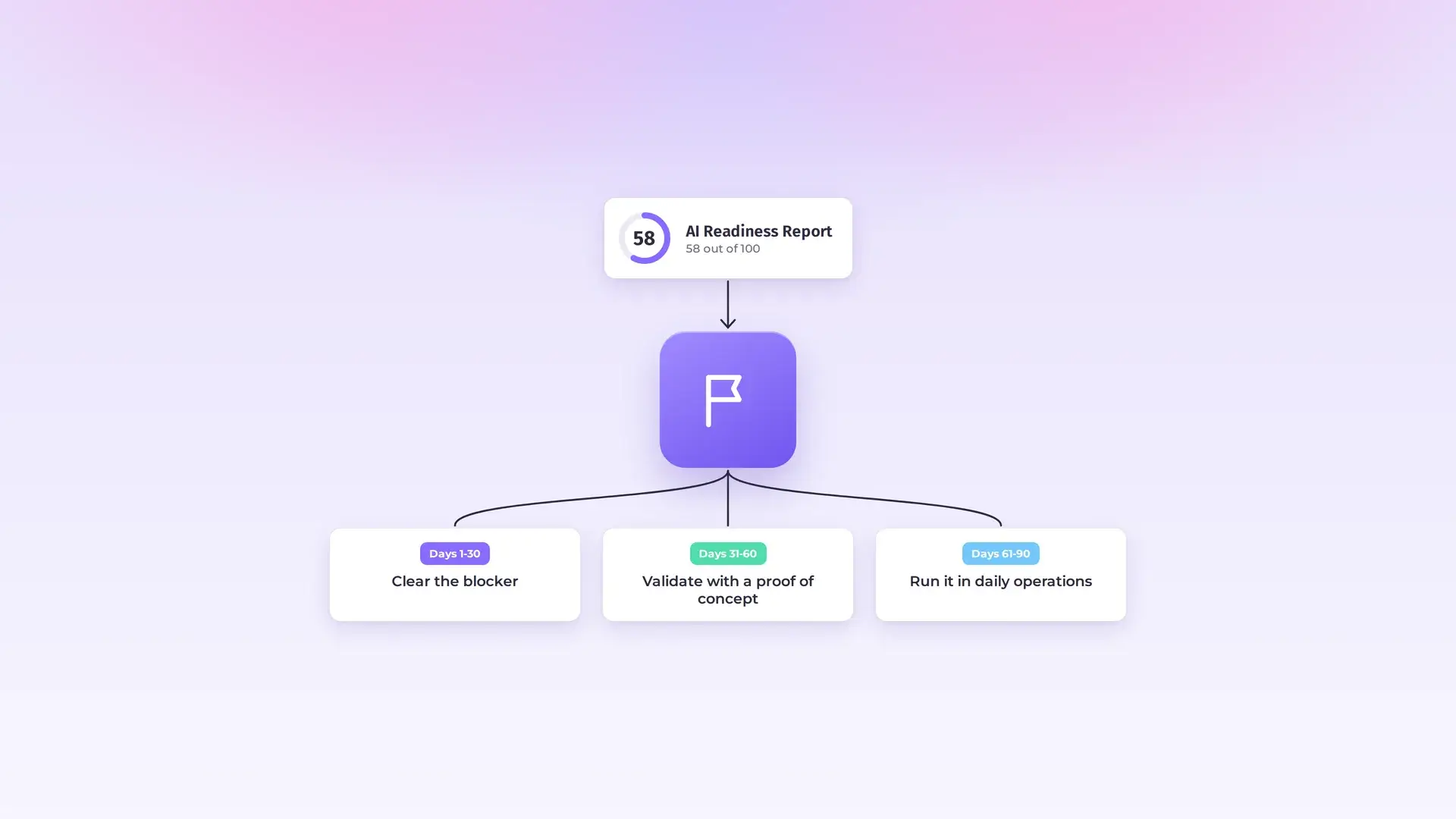
Days 1-30: Clear the blocker and define the target
- Name the owner. Here, that is the Head of Operations or someone they delegate with real decision power.
- Map how orders are processed today: the formats they arrive in, the exceptions, and roughly how many come in each week.
- Decide how success will be measured and record the baseline now. The share of orders entered without manual correction and the average handling time per order are both reasonable starting metrics.
- Settle the ERP access question with IT or the vendor. It was the report’s blocker, so it goes first.
Decision at day 30: is the workflow clear and the data accessible enough to test? If not, extend this phase rather than carrying an unresolved access problem into the build.
Days 31-60: Validate with a scoped proof of concept
A scoped proof of concept may typically be delivered in approximately 14–21 days, depending on data access, integrations, technical complexity, and client availability. Run it on real orders, with a person reviewing every output against the metric set in the first month.
Decision at day 60: did the test meet the threshold you set? If yes, move on. If it came close, adjust and retest. A clear miss is still worth having, since it cost a few weeks instead of a full implementation budget.
Days 61-90: Run it inside daily operations
- Put the solution into everyday use, with a written rule for which cases go to a person for review.
- The owner checks the metrics every week against the baseline from month one.
- At day 90, decide whether to extend to the next order channel, adjust, or stop.
Neurony has built this kind of workflow before, for Meesenburg, where email and document orders are processed into the ERP. In the Meesenburg implementation, 98% of processed orders required no manual modification. The Meesenburg case study shows how it was set up.
Expect your own dates to move. Integration work, internal approvals, and team availability all affect them. Keep the three decision points anyway, since they are what stop a pilot from running on indefinitely.
Have your results and want a second opinion?
Schedule a meeting with our team to go through your report and agree on a first workflow and next steps.
Ready to explore how this applies to your business?
Schedule a meeting with our team to discuss your goals and next steps.
Schedule a meetingWhen 90 Days Is the Wrong Frame
If your two lowest scores are Strategy Clarity and Leadership Readiness, the first 90 days should be spent on decisions, and building can come later. That is still a useful result, because it means the report has pointed at the thing to fix before money goes into development.
For that situation, a structured working session such as Neurony’s AI Worth Doing workshop helps leadership agree on which opportunities are worth pursuing. If you would rather have someone map opportunities from inside your operations, the Forward Deployed Engineer engagement ranks them by impact against effort. Both sit within Neurony’s AI Adoption approach.
Your Next Step
If you have your results, book 30 minutes this week with the person who will own the first workflow and go through the report in the order above: opportunity, blocker, next steps. By the end of that meeting you should have a name, a workflow, and a date for the day-30 decision. If you have not taken the assessment yet, start there.
See your roadmap. Take the AI Readiness Assessment
Book a call with our team