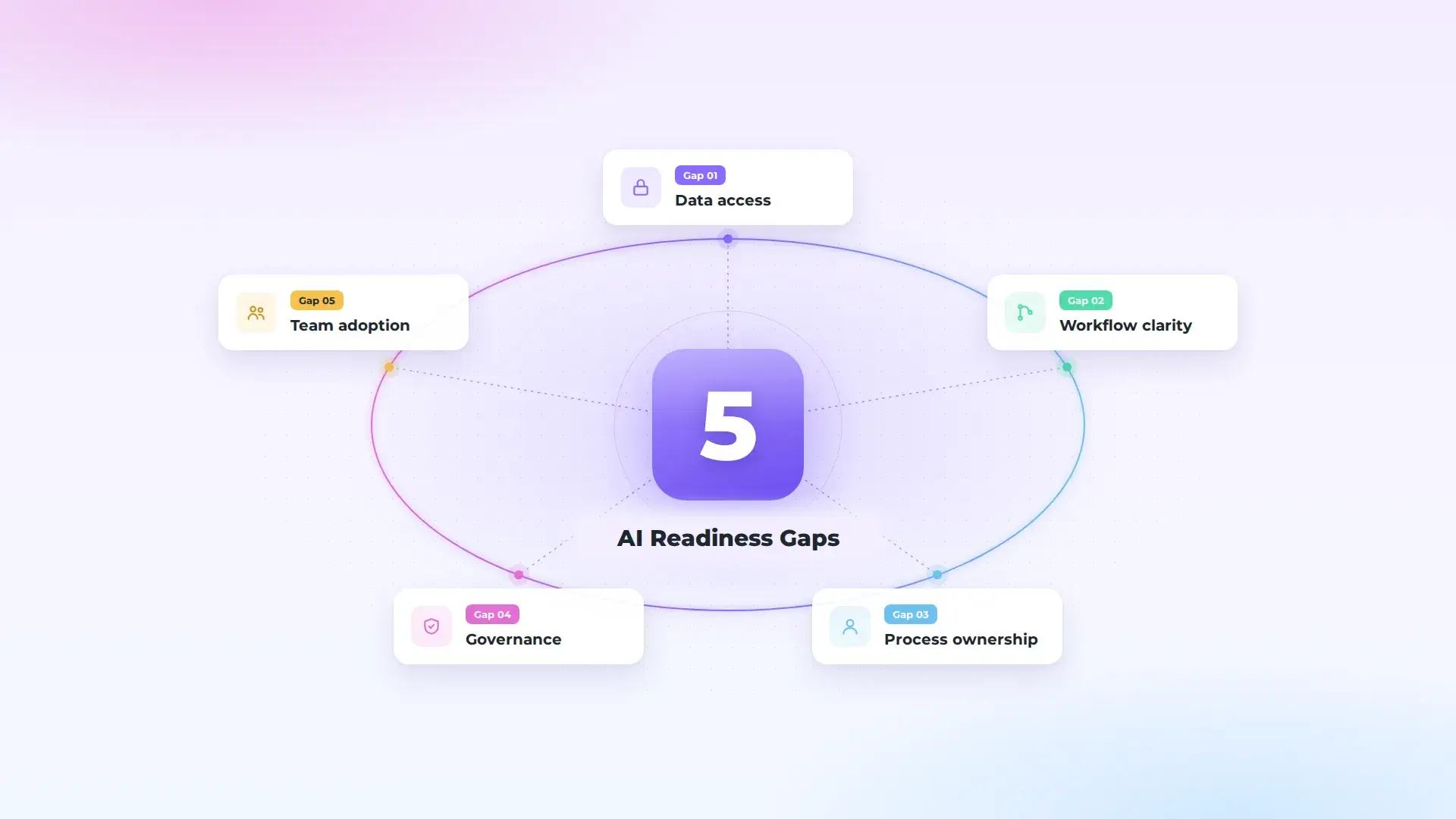








Using AI is not the same as being ready for AI. A company may already use ChatGPT, Claude, Copilot, or other AI tools across different teams and still struggle to turn that experimentation into reliable business value.
AI readiness is the ability of a company or department to adopt AI successfully because the business goals, leadership, processes, data and systems, and people required to support it are sufficiently prepared.
In practical terms, AI readiness is less about asking, “Are we using AI?” and more about asking, “Do we have the conditions to make AI useful here?”
What Does AI Readiness Mean for a Business?
AI readiness describes how prepared a business is to move from experimentation to practical adoption. It does not mean having perfect data, the newest technology stack, or a complete company-wide AI strategy before starting.
Instead, a company needs enough clarity around the problem it wants to solve, the process involved, the information AI would need, the people responsible for the work, and the outcome the business expects.
Consider two companies that both want to automate incoming customer orders. One knows exactly how orders are processed, where the required information lives, which systems are involved, where employees spend time manually checking information, and what a successful automation would need to achieve.
The other knows that order processing takes too long, but the workflow varies between employees, information is scattered across systems, and nobody has clearly defined what should actually be automated.
Both companies may have access to the same AI technology, but they are not equally prepared to implement it. That difference is AI readiness.
What Are the Signs of AI Readiness?
There is no single factor that determines whether a company is AI-ready. Readiness usually comes from several parts of the organization being sufficiently aligned.
A stronger starting point usually exists when the business has a clearly defined problem rather than a general ambition to “use more AI.” The relevant workflow should also be understood well enough to identify where time is being lost, where decisions happen, and which parts could realistically be supported by AI.
The information required for that workflow also needs to be accessible and reliable enough to use. At the same time, someone should own the initiative, have the authority to make decisions around it, and be prepared to support implementation beyond the initial experiment.
The people who will actually use the AI-enabled process matter just as much. Even a technically strong solution creates little value if employees do not trust it, understand why it is being introduced, or cannot fit it naturally into their existing work.
None of these conditions needs to be perfect. The important question is whether they are strong enough to support the specific AI opportunity the company is considering.
How Do You Know If Your Company Is Ready for AI?
One of the clearest signs of AI readiness is specificity.
There is a significant difference between saying, “We want to use AI in Operations,” and saying, “Our Operations team manually processes hundreds of incoming orders every month, we understand the steps involved, we know which systems contain the required information, and we can measure how much employee time the process consumes.”
The second company may not yet know exactly what the final AI solution should look like, but it understands the business problem well enough to evaluate whether AI is an appropriate way to solve it.
That is a much stronger starting point than choosing an AI tool first and then trying to find somewhere in the organization to use it.
What Are the Signs That a Company Is Not Ready for AI?
Low AI readiness does not mean a company should avoid AI. It usually means there are conditions worth addressing before committing significant time or budget to implementation.
Common warning signs include selecting tools before defining the business problem, running several disconnected AI experiments with no clear priority, targeting workflows that nobody can consistently explain, or depending on information that is fragmented across systems and difficult to access.
Readiness can also be weak when there is no clear owner for an initiative, when success has not been defined, or when the organization assumes employees will adopt a new AI workflow simply because the technology works.
Identifying these issues early is useful because they can be addressed before they become expensive implementation problems.
Can One Department Be Ready for AI While Another Is Not?
Yes. AI readiness is rarely uniform across an entire organization.
A Sales team may have structured CRM data, repeatable workflows, clear ownership, and several obvious opportunities for AI. Finance in the same organization may depend on legacy systems and fragmented information, while Legal may have stricter requirements around data access and human review.
This is why the question “Is our company ready for AI?” can sometimes be too broad. A more useful question is: “Which teams and workflows are ready for AI today?”
Companies do not always need to wait for an organization-wide AI transformation program before starting. One department with a clear problem, accessible information, strong ownership, and a suitable workflow can provide a much more practical starting point.
Not sure where AI could realistically create value in your business?
A short conversation with our team can help you look at your current workflows, priorities, and AI initiatives and identify where it makes sense to start.
Schedule a meeting with our team.
AI Readiness Is About Knowing Where You Can Start
Being AI-ready does not mean being ready to automate everything. It means understanding where the organization has enough clarity, process maturity, system support, leadership ownership, and people readiness to apply AI effectively.
Some workflows may already be strong candidates for AI, while others may require better processes, more accessible information, clearer ownership, or stronger alignment before AI will add meaningful value.
The important part is knowing the difference before implementation begins.
Understand Your Next Step
If you want to understand how AI readiness is evaluated, the next step is to look at what a structured assessment actually measures and how the results are used.
Read: What Is an AI Readiness Assessment? What It Measures and How It Works.
If you already have AI opportunities in mind and want to discuss where your company should start, schedule a meeting with our team.
Ready to explore how this applies to your business?
Schedule a meeting with our team to discuss your goals and next steps.
Schedule a meeting