







“Assess your AI readiness first” has become one of those phrases repeated across AI consulting, transformation programs, and technology conversations. But what does an AI readiness assessment actually assess?
An AI readiness assessment is a structured evaluation of whether a company, department, or business function has the conditions required to adopt AI successfully and generate measurable business value from it.
It looks beyond whether a company is interested in AI or already uses tools such as ChatGPT. A useful assessment examines whether the business has enough strategic clarity, leadership support, process visibility, usable data and systems, and people capability to turn AI into something operational.
For business and operations leaders, the purpose is simple: understand where AI can realistically create value today, what could prevent implementation, and what needs to improve before investing further.
This guide explains what an AI readiness assessment evaluates, how it works, why readiness can differ significantly between departments, and what you should expect from the final report.
What Is an AI Readiness Assessment?
An AI readiness assessment is a diagnostic process used to determine whether an organization or department is prepared to identify, implement, and scale valuable AI use cases.
In Neurony’s AI Readiness Assessment, readiness is evaluated across five core dimensions:
- Strategy clarity
- Leadership readiness
- Process visibility
- Data & systems
- People & skills
The objective is not simply to produce an “AI readiness score.”
A useful assessment should help answer more practical questions:
- Where are we already ready to use AI?
- Which workflows have the strongest potential?
- What could prevent an AI initiative from succeeding?
- Which gaps should we address before implementation?
- Where should we focus first?
That makes an AI readiness assessment different from a generic technology questionnaire. It connects organizational capabilities with the actual conditions required to implement AI.
What Does AI Readiness Mean?
AI readiness describes an organization’s ability to adopt AI in a way that produces sustainable business outcomes.
A company can be technologically advanced without necessarily being AI-ready.
For example, a business may already have a modern ERP, CRM, data warehouse, and cloud infrastructure but still struggle to implement AI if:
- the process being automated is poorly defined;
- teams cannot agree on the business problem;
- important data is incomplete or inaccessible;
- employees do not trust or adopt the new workflow;
- nobody owns the implementation after the pilot;
- security or compliance requirements have not been considered.
Similarly, a company does not need perfect infrastructure across the entire organization before it can start using AI.
A single department may already have the process clarity, data, ownership, and business need required for a successful AI implementation even while other departments are much less prepared.
That is why AI readiness should be evaluated in context rather than treated as one universal organizational score.
AI Readiness Assessment vs. AI Strategy
An AI readiness assessment and an AI strategy are related, but they serve different purposes.
An AI readiness assessment tells you where you are today.
An AI strategy defines where you want to go and how you intend to get there.
The assessment comes first because an AI strategy built without understanding existing constraints can easily turn into a list of ambitions disconnected from operational reality.
For example, a strategy might identify customer service automation as a priority. But a readiness assessment could reveal that customer information is fragmented across several systems, historical support data is inconsistent, and no team currently owns the knowledge base the AI system would depend on.
That does not necessarily mean the use case should be abandoned.
It means the strategy needs to account for those conditions before implementation begins.
An AI adoption effort comes later: that is the work of integrating AI into real workflows, systems, and teams and ensuring people actually use it.
Miruna-Cristina Bujor, Engagement Manager at McKinsey & Company, discussed this distinction between AI strategy and real adoption on the REWIRED podcast, drawing on her experience working with financial institutions through digital and AI transformation.
The sequence is therefore:
Assess readiness → define priorities → build the AI strategy → implement → drive adoption → measure results.
Skipping the diagnostic stage does not remove the underlying problems. It usually means discovering them later, when implementation has already started and they are more expensive to fix.
What Does an AI Readiness Assessment Evaluate?
Neurony’s AI Readiness Assessment evaluates five dimensions that together show whether a department has the foundations required for practical AI adoption.
1. Strategy Clarity
Strategy clarity looks at whether the team can connect AI to a real business priority instead of treating AI as a goal by itself.
The assessment explores questions such as:
- What are you trying to improve?
- Why does that problem matter?
- Which outcomes would make an AI initiative worthwhile?
- Are priorities clear enough to decide what should come first?
A team asking “Where can we use AI?” is still exploring. A team asking “How can we reduce the manual effort required to process incoming orders without lowering accuracy?” is much closer to a viable starting point.
2. Leadership Readiness
Leadership readiness looks at whether there is enough sponsorship, ownership, and decision-making support to move an AI initiative beyond experimentation.
The assessment considers whether leaders are engaged, whether priorities have owners, and whether someone can make decisions when implementation requires trade-offs.
Interest in AI is useful, but interest alone does not create adoption. A promising initiative still needs a business owner who can support it, prioritize it, and help remove blockers.
3. Process Visibility
AI works best when the workflow it is meant to improve is understood.
Process visibility looks at whether the team can clearly describe:
- which steps happen today;
- which tasks are repetitive or manual;
- where delays or handoffs occur;
- which decisions require human judgment;
- which exceptions need special handling;
- how often the workflow happens and who is involved.
The purpose is not to create perfect process documentation. It is to understand the work well enough to identify where AI could realistically help.
4. Data & Systems
AI initiatives rarely operate in isolation. They usually depend on the data and systems already supporting the workflow.
This dimension looks at factors such as:
- where relevant information lives;
- how accessible and reliable it is;
- whether important data is fragmented across tools;
- which ERP, CRM, internal platforms, databases, or cloud tools are involved;
- whether existing systems can support a reliable AI-enabled workflow.
A use case can look attractive on paper but still be difficult to implement if the required data is inaccessible or the workflow depends on disconnected systems.
5. People & Skills
The final dimension looks at whether the people involved are prepared to work with AI in practice.
That includes questions around current AI usage, familiarity with AI tools, confidence, adoption, and whether the team has the skills or support needed to use a new workflow effectively.
A technically successful AI solution can still fail if the people expected to use it do not understand it, trust it, or see how it fits into their work.
Why AI Readiness Should Be Assessed by Department
One of the limitations of many AI readiness models is that they reduce the entire organization to a single score.
For example: “Your organization is 68% AI-ready.”
That number may be easy to understand, but it can hide the information leaders actually need.
AI readiness can differ dramatically across departments.
A Sales team may have structured CRM data, clearly defined workflows, strong management ownership, and several repetitive tasks suitable for AI.
The Legal department in the same company may face stricter data restrictions, very different workflows, and higher requirements for human review.
Finance may have excellent process documentation but depend on legacy systems that are difficult to integrate.
Marketing may already use several AI tools but have limited visibility into whether they produce measurable business value.
The company cannot accurately be described as simply “ready” or “not ready.”The more useful question is: Which parts of the organization are ready to apply AI to which workflows?
That is why Neurony’s AI Readiness Assessment can be completed by department.
The assessment currently covers: Sales, Marketing, Finance, Operations, Legal, HR, IT, Customer Support, Procurement, and R&D.
A department head can assess only the function they control. A leadership team can assess several departments and compare where the strongest opportunities and biggest gaps exist. This produces a much more actionable picture than averaging unrelated parts of the organization into one company-wide score.
Can You Assess Just One Department?
Yes. You do not need to launch a company-wide AI transformation program before assessing AI readiness. In many cases, starting with one department is more useful.
A COO, CFO, Head of Customer Support, Sales Director, or Operations Manager can assess the workflows within their own area and identify where AI adoption may already be realistic.
This makes it possible to answer a much narrower and more useful question: “Where can my team use AI effectively?” rather than waiting until the entire organization has created a centralized AI strategy.
Department-level assessment also makes it easier to identify a strong first use case.
A successful implementation in one function can then provide evidence, operational experience, and internal confidence before AI adoption expands more broadly.
How Does an AI Readiness Assessment Work?
AI readiness assessments generally fall into a few categories.
Some use downloadable checklists.
Others use fixed online questionnaires.
Some generate a numerical score compared with an industry benchmark.
These formats can provide a useful first indication, but fixed questionnaires have an important limitation: they cannot always explore the context behind an answer.
For example, two companies might both answer:
“Yes, we use a CRM.”
But that tells us very little about readiness. One company may have complete, structured customer information used consistently by its sales team.
Another may technically have a CRM while most important information still lives in spreadsheets, email threads, and individual employees’ notes.
The same answer can therefore represent two very different levels of AI readiness.
This is why a useful readiness assessment should explore context rather than simply count yes/no responses.
How Neurony’s AI Readiness Assessment Works
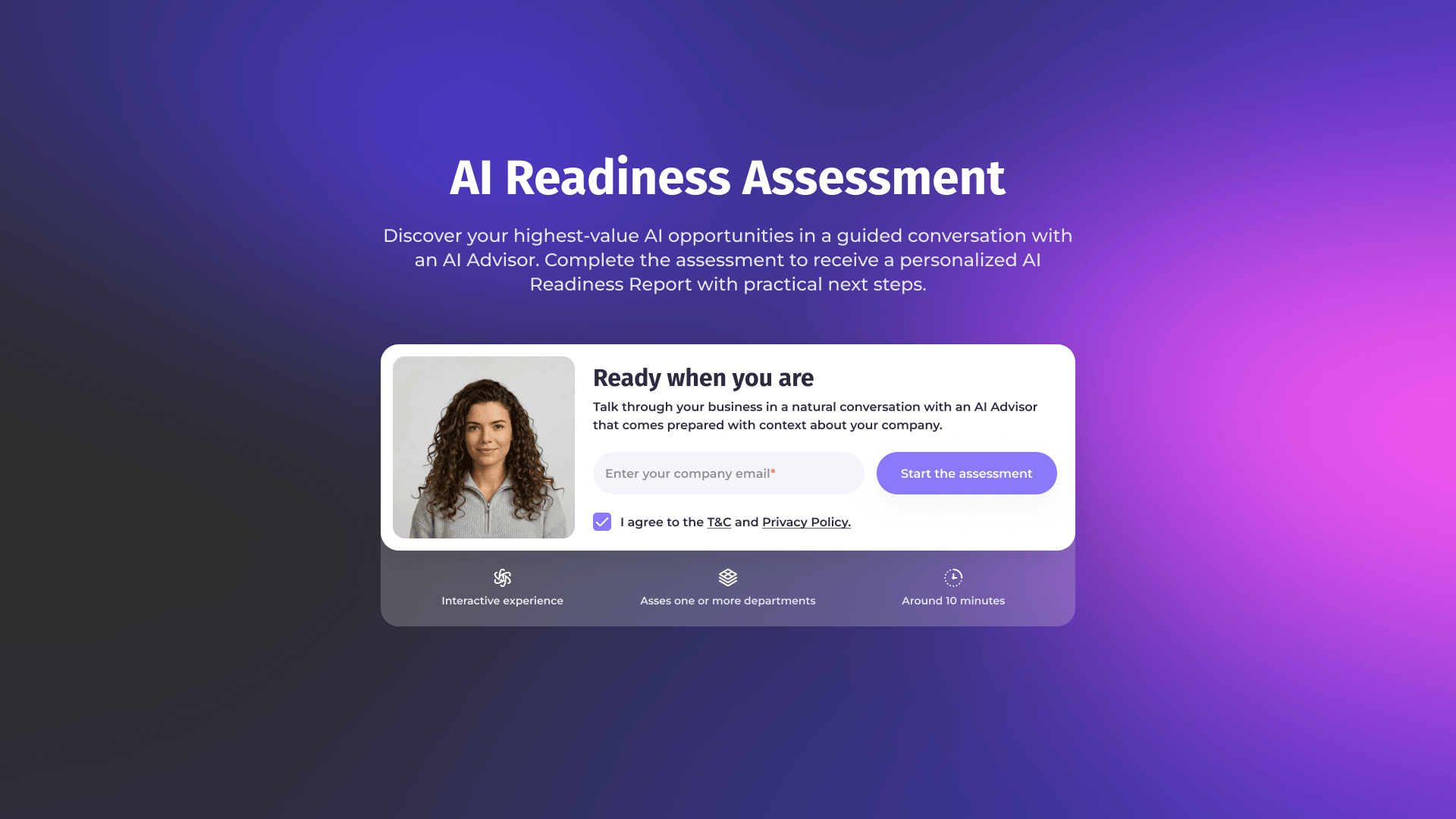
Neurony’s AI Readiness Assessment is designed as a guided conversation rather than a static questionnaire.
The goal is to understand the context behind each answer and identify the workflows, constraints, and opportunities that are most relevant to the company or department being assessed.
The process begins with your work email.
Before the conversation starts, the AI Advisor uses publicly available information associated with your company to understand basic business context.
That means the conversation does not need to begin with a long series of generic questions about what your organization does.
Instead, it can start closer to the actual business context and adapt its follow-up questions based on your responses.
If you mention, for example, that your Operations team spends significant time manually processing orders received by email, the conversation can explore:
- how orders arrive;
- what information employees extract;
- which systems are involved;
- where product or customer information is stored;
- what exceptions require manual decisions;
- which parts of the process are repetitive.
The assessment therefore becomes less about scoring abstract AI maturity and more about understanding whether the conditions exist for practical AI adoption.
You can assess one department or several.
The process usually takes around 5–10 minutes, depending on the number of areas you choose to evaluate and the level of detail in your answers.
What Do You Get From Neurony’s AI Readiness Assessment?
Completing the assessment produces a personalized AI Readiness Report, not just a questionnaire result.
The report is designed to show both how ready the assessed area is today and what you can realistically do next.
Your AI Readiness Score
You receive an overall AI Readiness Score out of 100, together with a readiness level that gives you a quick indication of where the assessed department currently stands.
The score is supported by five individual readiness dimensions:
- Strategy Clarity
- Leadership Readiness
- Process Visibility
- Data & Systems
- People & Skills
This makes it possible to see not only your overall readiness, but also where the strongest foundations and biggest constraints are.
An Executive Summary of Your Current Situation
The report then turns the conversation into a concise analysis of the department you assessed.
Rather than simply repeating your answers, it identifies patterns across your workflows, objectives, systems, pain points, and current AI usage.
For example, the report may identify that a process is already well documented while fragmented systems, unclear priorities, or limited ownership could make implementation harder.
Your Biggest Opportunity
The report identifies the most relevant opportunity surfaced during the assessment.
This is tied to the actual work described during the conversation rather than selected from a generic list of AI use cases.
In one assessment, for example, the report identified approximately four hours per month spent researching AI news, getting manager approval, testing different agents and skills, and publishing content as the clearest automation candidate.
That changes the question from: “How mature are we?” to: “Where could we start?”
Recommended Next Steps
The report also provides concrete recommendations based on what the assessment surfaced.
These recommendations can include both potential AI initiatives and foundational work that should happen first.
For example, recommendations may point toward:
- a department-specific workflow copilot;
- improving data and systems integration;
- clarifying AI priorities, ownership, and the first pilot through an AI adoption strategy.
This distinction matters. An AI readiness assessment should not always tell you to immediately build an AI solution. Sometimes the most valuable finding is understanding what needs to change before an AI initiative is likely to work reliably.
Recommended Follow-Up
The report can also indicate whether additional departments should be assessed or whether the current findings are sufficient to move into a next step.
The result is a more practical starting point for prioritization than a score on its own.
What Happens After an AI Readiness Assessment?
An AI Readiness Report is not the final step.
It is the input to a more informed decision about what to do next.
Depending on the findings, the next step may be:
- identifying and prioritizing AI use cases;
- improving a specific dataset;
- documenting a workflow;
- resolving system-access issues;
- defining success metrics;
- testing one department-level use case;
- creating a broader AI adoption roadmap.
A company with strong readiness in one operational area may be able to move directly into use-case validation.
Another company may discover that its biggest opportunity is not building an AI system immediately, but first improving the processes or data that such a system would depend on. Both are useful outcomes. The value of the assessment is not proving that a company is “AI-ready.” It is showing leadership what the most sensible next step actually is.
AI Readiness Assessment FAQs
What is the purpose of an AI readiness assessment?
The purpose of an AI readiness assessment is to determine whether a company or department has the strategic, leadership, process, systems, and people foundations needed to successfully adopt AI.
It helps identify where AI can realistically create value, what barriers could prevent implementation, and which areas should be improved or prioritized first.
How do you measure AI readiness?
In Neurony’s assessment, AI readiness is measured across five dimensions: Strategy Clarity, Leadership Readiness, Process Visibility, Data & Systems, and People & Skills.
These dimensions are scored individually and contribute to an overall AI Readiness Score out of 100.
Is an AI readiness assessment the same as an AI maturity assessment?
Not necessarily. An AI maturity assessment often measures how advanced an organization already is in its use of AI. An AI readiness assessment focuses more directly on whether the conditions exist to successfully adopt or expand AI. A company can have relatively little existing AI adoption while still being highly ready to implement a well-defined use case.
Who should complete an AI readiness assessment?
An AI readiness assessment can be useful for CEOs, COOs, CIOs, CTOs, department leaders, operations managers, transformation leaders, and other decision-makers responsible for improving business processes or evaluating AI initiatives.
It can also be completed at department level without requiring the entire organization to participate.
Does a company need an AI strategy before completing an assessment?
No. In most cases, the assessment should come first. The assessment establishes where the company currently stands. That information can then be used to create a more realistic AI strategy and prioritize initiatives based on actual business conditions.
How long does an AI readiness assessment take?
Neurony’s AI Readiness Assessment typically takes around 5–10 minutes, depending on how many departments you choose to assess and how detailed your responses are.
Do you need technical knowledge to complete an AI readiness assessment?
No. The assessment should focus primarily on your business, workflows, systems, data, challenges, and objectives. You do not need to understand AI models, APIs, machine learning, or technical architecture to provide useful answers.
What do you get after completing Neurony’s AI Readiness Assessment?
You receive a personalized AI Readiness Report with an overall score out of 100, five dimension-level scores, an executive summary, the biggest opportunity identified during the conversation, recommended next steps, and any recommended follow-up.
Is the AI Readiness Score benchmarked against assessed peers?
Not yet. The current report uses industry reference estimates rather than a benchmark built from assessed peer companies.
That means the report should be used primarily to understand your own readiness profile, strengths, constraints, and next steps rather than as a peer-ranking tool.
Can a company be ready for AI in one department but not another?
Yes. AI readiness often varies significantly between departments because each function has different workflows, systems, data, risks, and levels of ownership.
That is why department-level assessment can provide more useful information than a single company-wide AI readiness score.
Assess Your Company’s AI Readiness
You do not need to already know whether your organization is ready for AI. That is the point of the assessment.
In approximately 5–10 minutes, Neurony’s AI Readiness Assessment helps you identify where the foundations for AI adoption are already strong, where important gaps remain, and which departments or workflows deserve further attention.
You can start with one department or assess several areas of the organization.